
Learning how to start an affiliate program for SaaS comes down to nine decisions made in order. You set the commission, the cookie window, the hold period, payouts, terms, tracking, tax forms and your first partners. Most founders can make every one of them in a week.
One thing to know first: we make OpenPromoter, an open-source affiliate tool, and this guide names it in one section near the end. Every rule here was checked in November 2026 against IRS, FTC and Stripe documentation and the OpenPromoter source code.
The sections below follow the order you will meet each choice. They start with a readiness check and the full step list. Then come commission math with worked numbers, refunds and payouts, program terms, testing, tax forms, recruiting and the mistakes to skip.
What a SaaS Affiliate Program Is and When You Are Ready
A SaaS affiliate program pays outside partners a share of the subscription revenue from customers they refer. The share often repeats every month the customer keeps paying. Partners get a tracked link or coupon code, and your billing system tells the affiliate tool when a referred customer pays.
Three things should be true before you invite a single partner:
- Customers already recommend you: If nobody mentions your product to a friend today, a commission will not change that habit.
- You know your refund policy: You will hold commissions until refunds settle. The hold length depends on that window.
- You can afford to share revenue: A commission is a cost of winning a customer, like an ad or a sales call.
If one of these is missing, fix it before launch. A program started too early mostly pays people for customers who would have bought anyway.
The terms you pick at launch also tend to stay in force for years. Partners build content around your rate and cookie window.
Changing them later costs trust. The extra week of planning earns its cost back.
How to Start an Affiliate Program for SaaS in 9 Steps
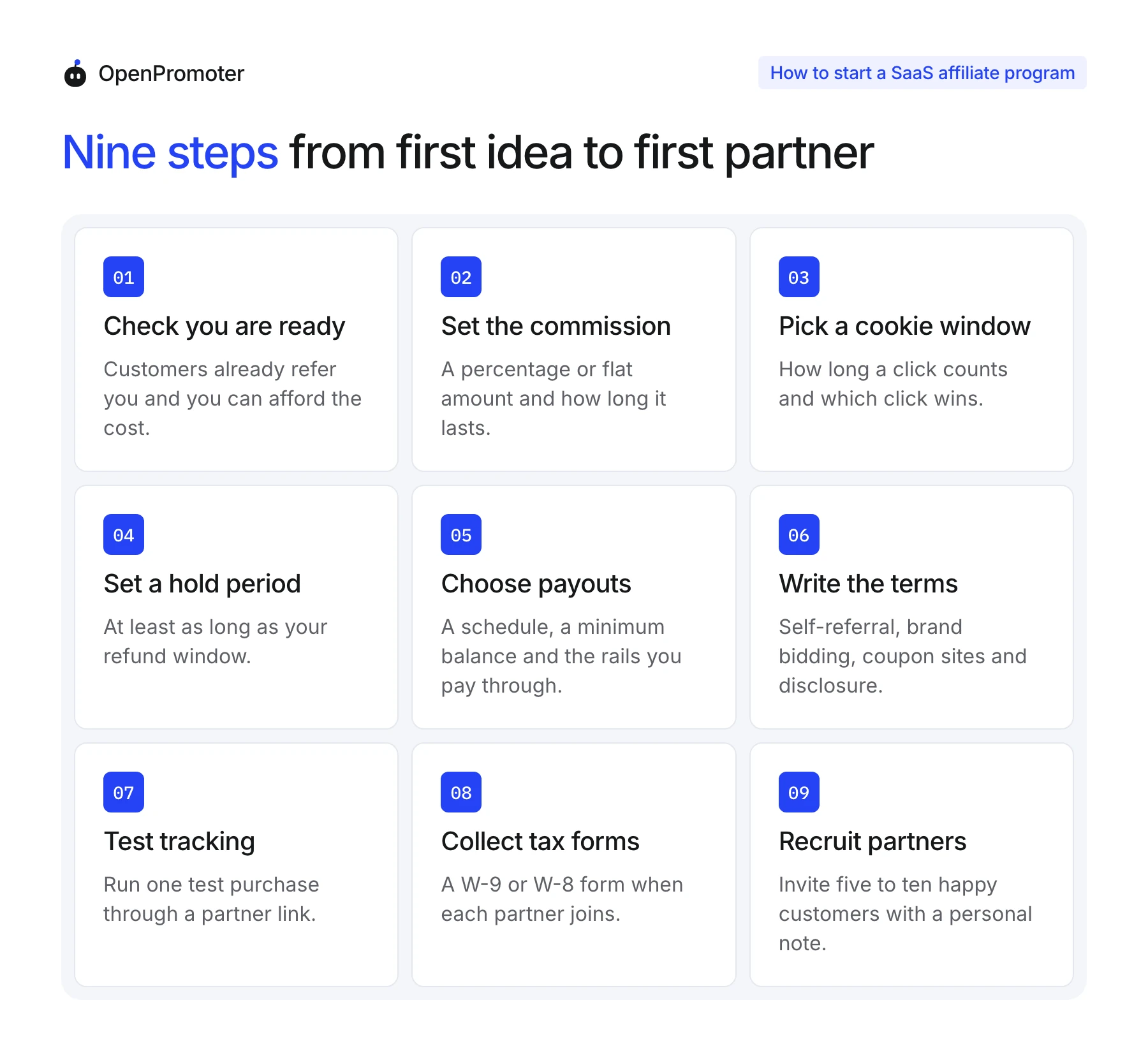
How to start an affiliate program for SaaS fits in nine steps you can finish in about a week. Each step is one decision, and each one depends on the step before it. The list below is the order, and the sections after it explain every step with numbers.
- Check that you are ready: Confirm customers refer you, your refund window is set and you can afford the cost.
- Set the commission: Pick a percentage or a flat amount and decide how many months it lasts.
- Pick a cookie window: Choose how long a click keeps counting and whether first or last click wins.
- Set a hold period: Hold every commission at least as long as your refund window.
- Choose payouts: Pick a schedule, a minimum balance and the rails you will pay through.
- Write the terms: Cover self-referral, brand bidding, coupon sites and FTC disclosure in plain words.
- Set up and test tracking: Connect your billing system and run one test purchase through a partner link.
- Collect tax forms: Ask for a W-9 or W-8 form when each partner joins.
- Recruit your first partners: Invite five to ten happy customers with a personal note.
After launch, a short list of numbers tells you whether the program works. The measuring section near the end covers which ones to watch in the first 90 days.
How Much Commission Should a SaaS Program Pay?
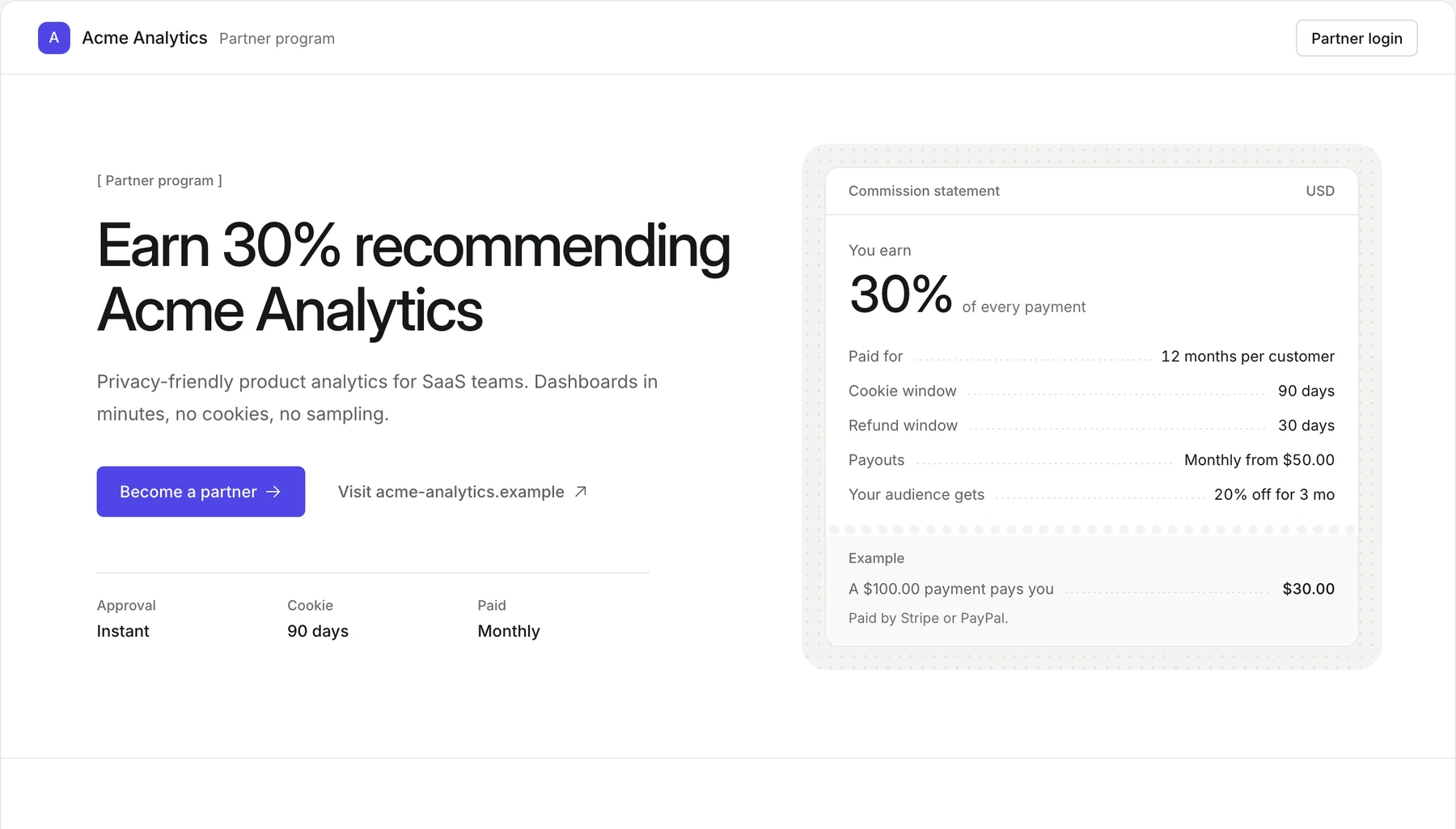
A SaaS affiliate program usually pays a percentage of each payment for a set number of months. The right affiliate commission rate is the one you would happily pay to win that customer through any other channel. Start from your plan price and your cost of acquiring a customer today.
SaaS programs pay in one of two ways:
- A percentage of revenue: The partner earns a share of what the customer pays. This fits subscriptions because the reward grows with the account.
- A flat bounty: The partner earns a fixed amount per paying customer or per signup. This fits when your plans vary a lot in price.
Then decide how long a percentage lasts. The usual choices are the first payment only, a fixed number of months or the life of the subscription.
A recurring commission is what makes SaaS partners take a program seriously. A creator who earns once per sale has little reason to keep a review updated. A creator who earns monthly does.
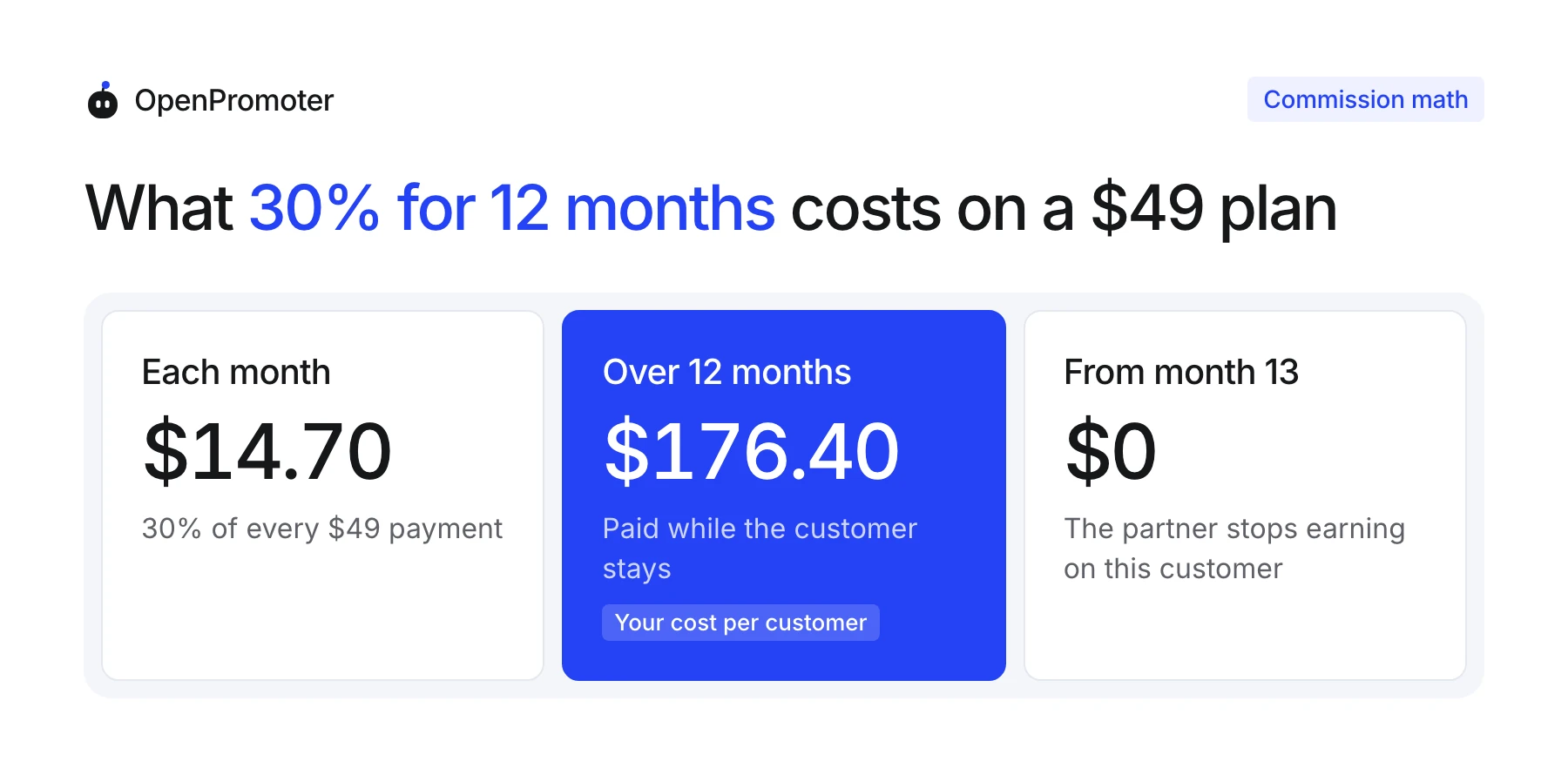
Here is an example with round numbers. A $49 a month plan at 30% for 12 months pays the partner $14.70 a month. Over the full year that comes to $176.40 for one customer.
Ask whether you would pay $176.40 to win that customer through an ad. If yes, the offer works. If the number scares you, shorten the duration before you cut the rate, because partners notice the rate first.
OpenPromoter's setup wizard reads your Stripe prices and proposes a starting design. The rules live in its open-source code, where you can read why each number appears:
| Your typical price | Proposed commission | Duration | Cookie window |
|---|---|---|---|
| Under $15 a month | 40% | Lifetime | 60 days |
| $15 to $499 a month | 30% | 12 months | 60 days |
| $500 a month or more | 20% | 12 months | 90 days |
| One-off price under $500 | 35% | Once | 60 days |
| One-off price of $500 or more | 20% | Once | 90 days |
The cookie also moves to 90 days when you sell annual plans or charge $200 a month or more. When gross margin is under 50%, the wizard cuts the rate to 60% of these numbers, with 10% as the floor.
A low price gets a lifetime share because 30% of a $10 plan is only $3 a month, which few partners chase for one year. A high price gets a lower rate because 20% of $500 is still $100 a month per customer.
A discount for the referred customer gives the partner something to offer. The wizard proposes 20% off the first three months for plans at $15 a month or more. On a cheaper plan it leaves the discount off, since the lost margin outweighs the lift.
Tiers reward the partners who sell. The default adds 5 percentage points after $5,000 in referred revenue and 10 points after $25,000.
Pick a Cookie Window and Attribution Model
The cookie window is how long a partner's click keeps counting after the visitor leaves your site. Pick a window longer than your free trial, because SaaS buyers often compare tools for weeks. Then choose whether the first or the last partner gets credit when two partners touch one buyer.
A short window means partners lose credit for sales they started. If your trial is 14 days and the window is 30, a buyer who waits two weeks before trying still counts.
You also choose the attribution model:
- Last click: The sale goes to the most recent partner. This rewards the partner who closed the deal.
- First click: The sale goes to the partner who found the buyer first. This rewards discovery and early content.
Pick one and write it in your terms. Partners care less about which model you choose than about knowing it before they promote you.
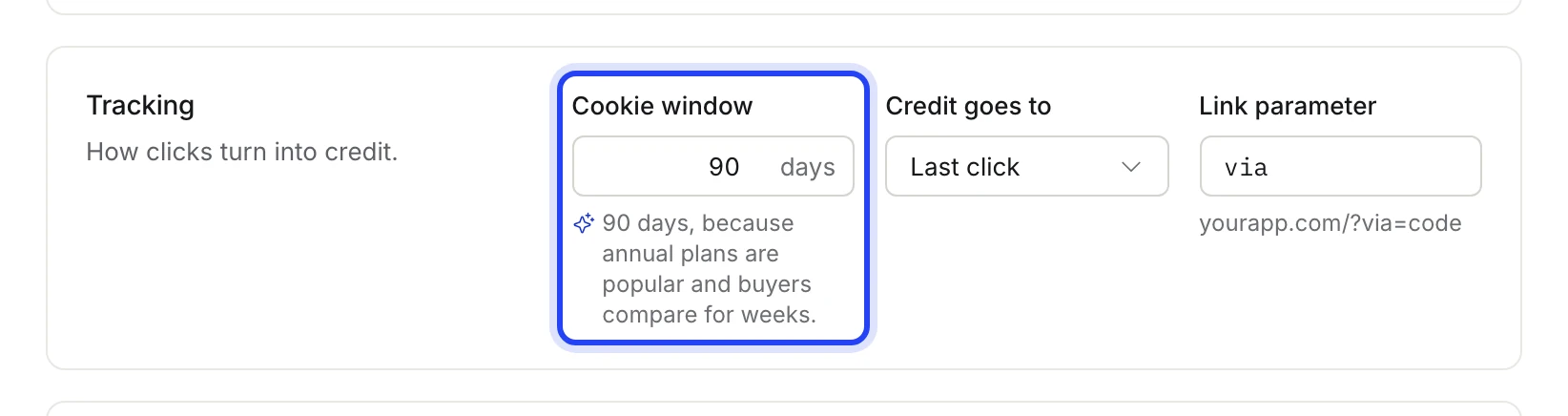
Cookies are only one signal, and browsers and ad blockers drop them. A coupon code, a click id passed to checkout and the email recorded at signup all credit sales with no cookie. The affiliate tracking setup guide shows the order OpenPromoter checks them in, with the coupon first.
Hold Commissions Through Your Refund Window
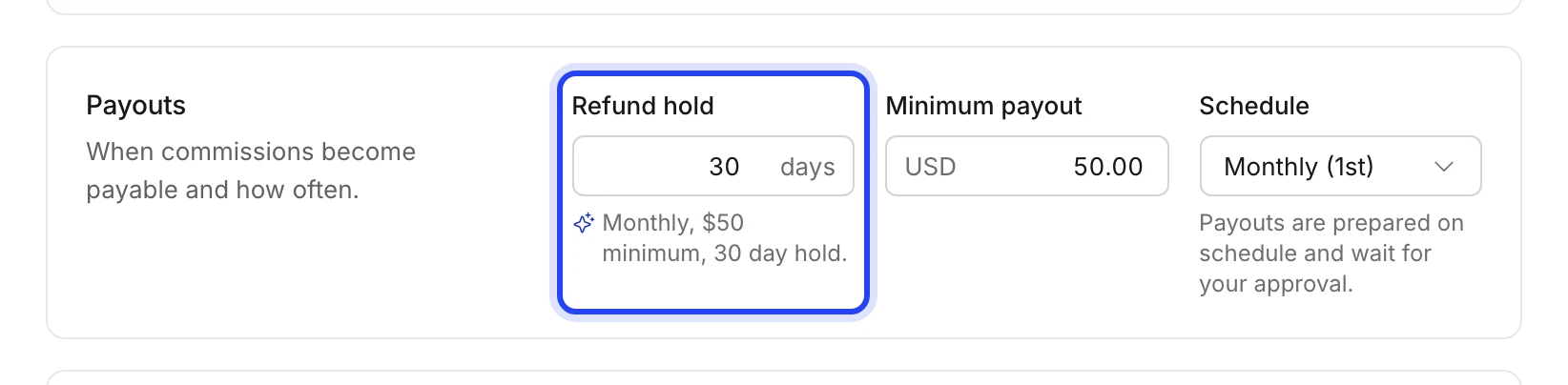
A hold period keeps each new commission pending until the sale can no longer be refunded. Set the hold to at least your refund window. A 30 day refund policy needs a 30 day hold or longer. A commission only becomes payable once the hold ends.
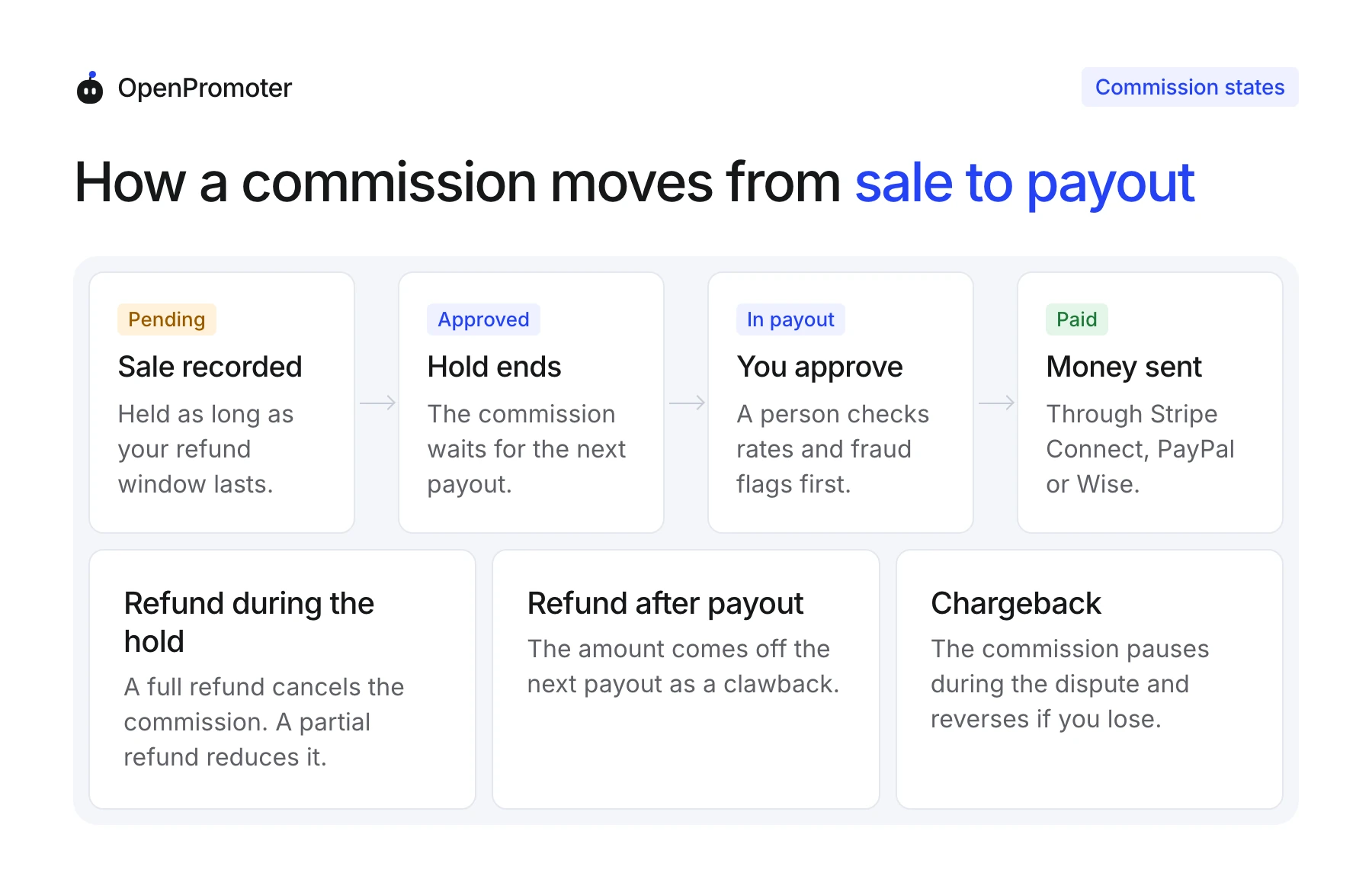
During the hold, a full refund cancels the commission and a partial refund reduces it in proportion. After the hold, the commission is approved and waits for the next payout.
A refund that arrives after payout should come off the partner's next payout as a clawback. A chargeback works the same way. The commission is paused while the dispute is open, and it is reversed if you lose.
Write all three cases into your terms before launch. A partner who sees a negative line without warning will assume the worst. Our docs list the full set of commission states and clawbacks, from pending to reversed.
Choose a Payout Schedule and Payout Rails
A monthly payout after the hold period ends is the simplest schedule to run. A minimum balance, such as $50, stops tiny payouts that cost more in fees than they are worth. Pick your payout rails before launch, since each one charges its own fee and needs its own setup.
Monthly payouts are the easiest to reconcile with your books. Weekly payouts feel generous, but they multiply the fees and the approvals.
The usual rails are Stripe Connect, PayPal Payouts and Wise. Stripe Connect pays from your Stripe balance after the partner finishes Stripe's own onboarding. PayPal and Wise pay from those business accounts.
Some affiliate tools also take a share of every payout on top of the rail's fee. Check that number before you choose a tool, because it grows with your best partners. You can see how affiliate payouts with 0% fees work in OpenPromoter.
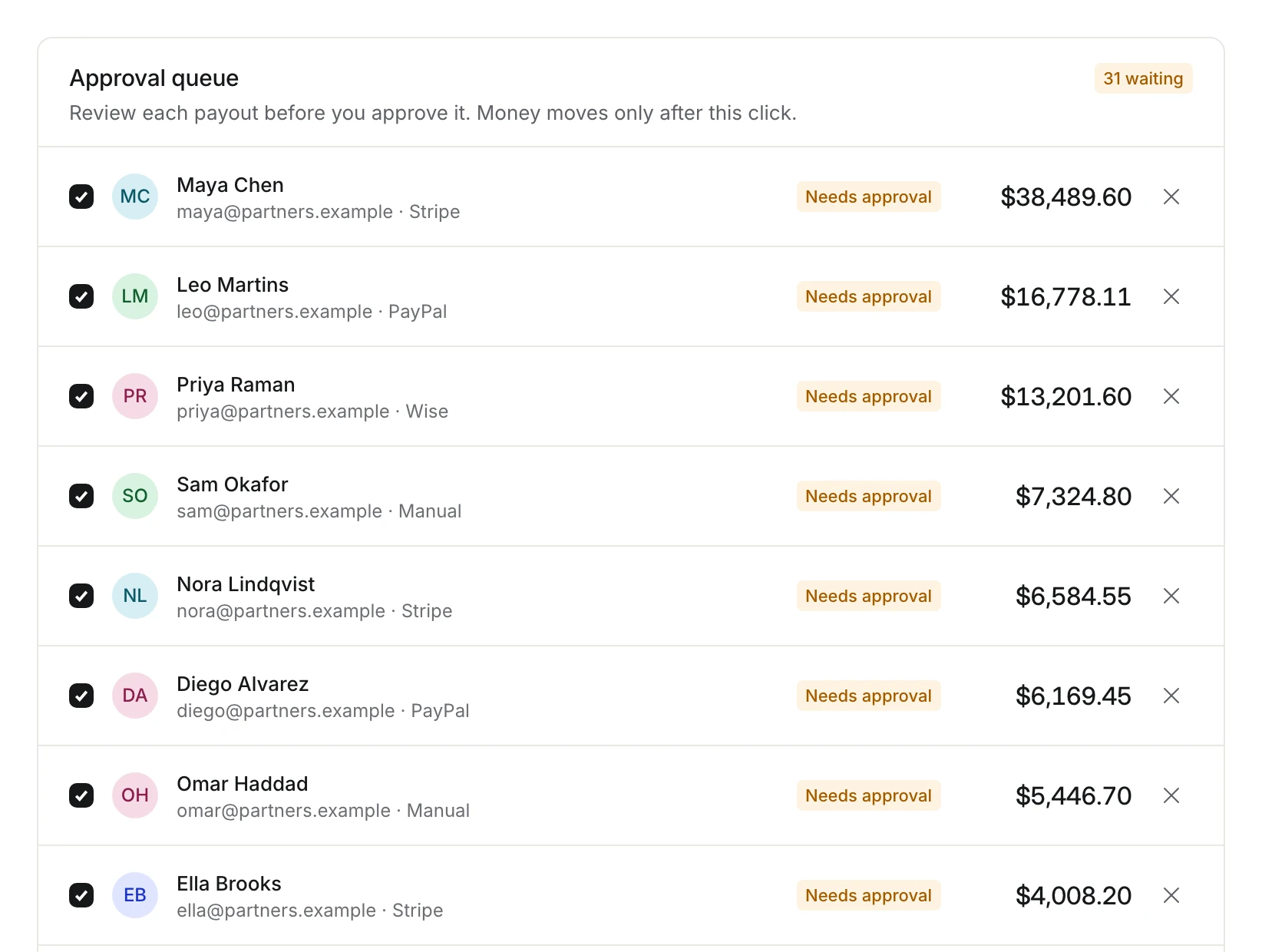
Tip: Have a person approve every payout batch. A wrong rate or a fraud flag is much easier to fix before money moves than after.
Write Program Terms Partners Will Read
Program terms are the short contract that says what earns a commission and what forfeits one. Keep them to one page so partners read them before they promote you. Clear terms settle most disputes before they start, because both sides agreed to the rule in advance.
Cover these points at least:
- Rate and duration: Say exactly what earns money, how much and for how many months.
- Cookie window and attribution: Say how long a click counts and whether first or last click wins.
- Hold and payout schedule: Say when money becomes payable and when it is sent.
- Self-referral: Partners cannot earn on their own purchases or their own accounts.
- Brand bidding: Say whether partners may bid on your name in paid search ads.
- Coupon sites: Say whether codes may appear on coupon and deal sites.
- Disclosure: Require partners to tell readers they earn a commission.
- Your right to reverse: Say that fraud and broken terms forfeit the commission.
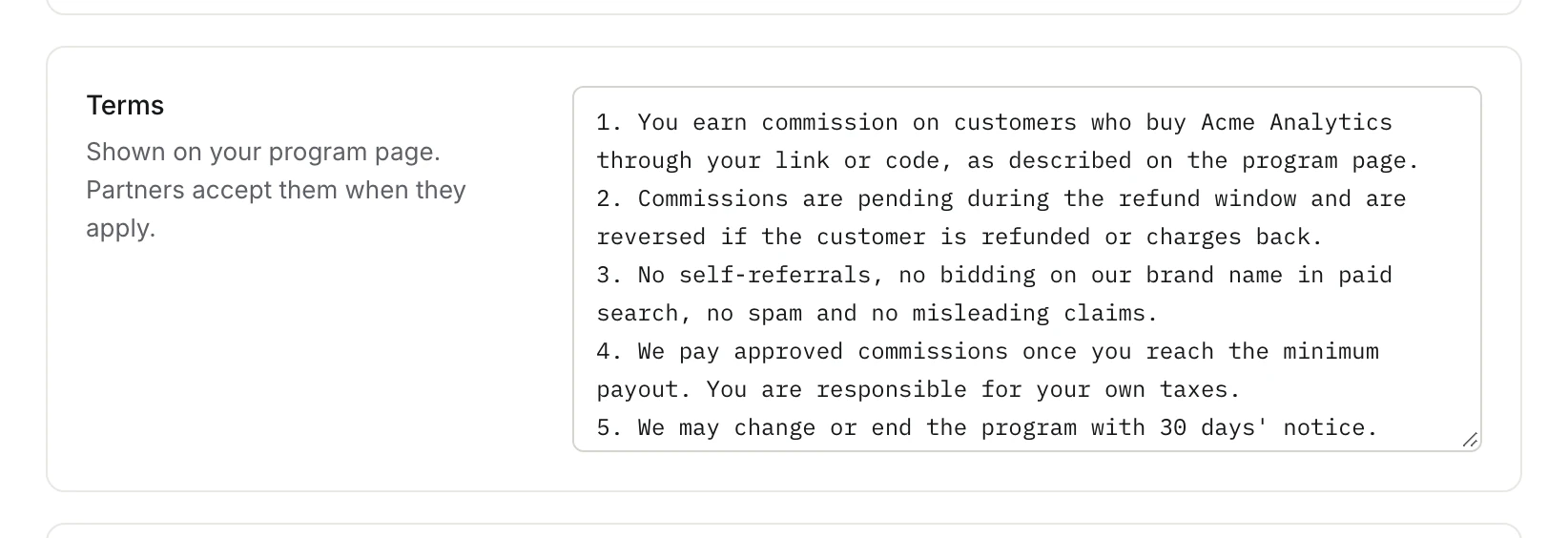
The disclosure rule protects you too. The FTC says affiliate marketers should disclose the relationship in a place readers will see it. Its Endorsement Guides FAQ also says advertisers need "reasonable programs in place to train and monitor members" of their network.
So put the disclosure rule in the terms and check new partners' pages once in a while. The FTC suggests plain wording such as "I get commissions for purchases made through links in this post."
Set Up Tracking and Test It Before Launch
Affiliate tracking has two halves that must both work before you invite partners. A script on your site records the partner's click. Your billing system then tells the affiliate tool when the referred customer pays, and that payment is what books the commission.
The second half matters most. Commissions should come from paid invoices and never from page views or checkout visits. A tool that reads your Stripe, Paddle, Lemon Squeezy, Polar or Chargebee webhooks books the commission when the money arrives.
With Stripe affiliate tracking, the click id rides along in the checkout session. Stripe Payment Links and the Pricing Table pick it up with no extra code.
Then test the whole path once. Open a partner link and buy with Stripe's test card 4242 4242 4242 4242 in test mode. Stripe's testing docs note that sandbox transactions "don't move funds". The test costs nothing.
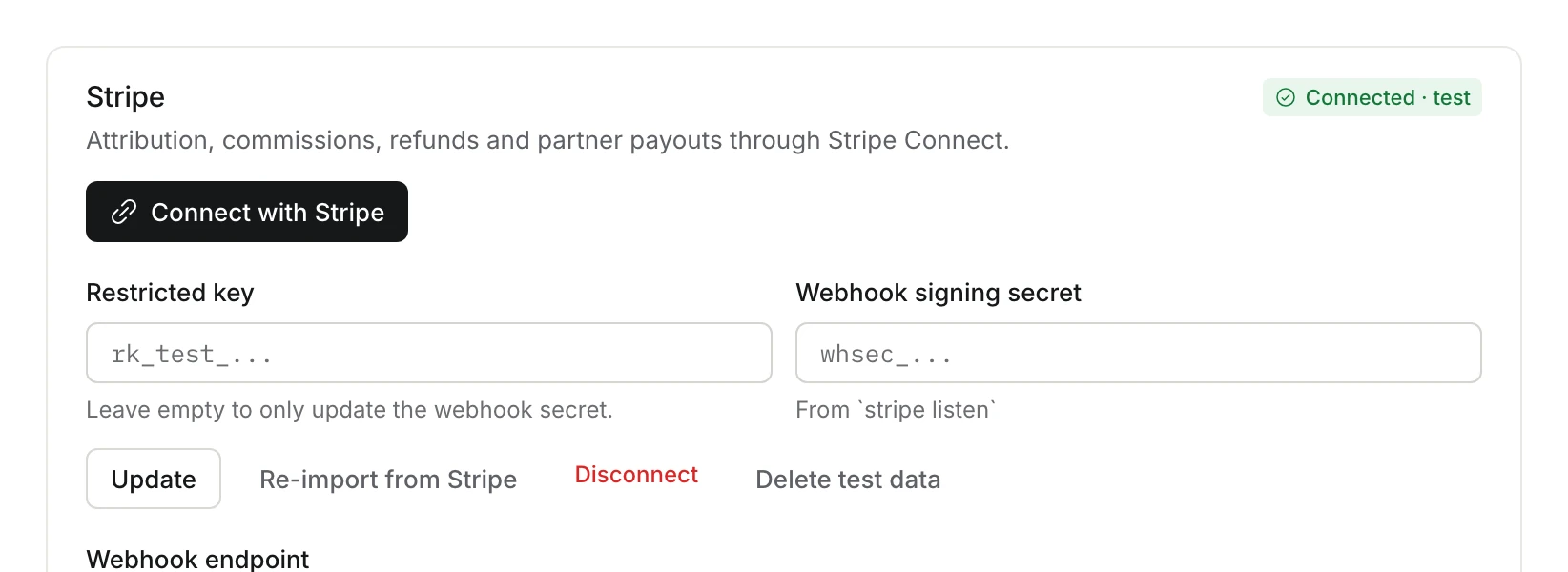
Watch the commission appear as pending in the affiliate tool. In OpenPromoter, test commissions carry a Test badge. Remove them in Settings > Integrations > Delete test data before you go live.
Collect Tax Forms When Partners Join
US companies paying affiliates need a Form W-9 from each US partner and a Form W-8BEN or W-8BEN-E from each foreign one. Collect the form when the partner joins. That beats chasing tax ids in January, when the 1099-NEC deadline is close.
The Form W-9 exists so a payee can "provide your correct Taxpayer Identification Number (TIN)" to the payer. Foreign individuals use the Form W-8BEN, which the IRS says to give "to the withholding agent or payer." Foreign entities use the W-8BEN-E.
The reporting threshold changed for 2026. The IRS 1099 instructions say the minimum "increased to $2,000 and may be adjusted for inflation beginning in calendar year 2027." It was $600 before.
So a US partner you pay $2,000 or more in 2026 usually needs a 1099-NEC. The same IRS page says to "file Form 1099-NEC on or before January 31."
Our guide to 1099 rules for affiliates covers backup withholding and the edge cases. It is general information and not tax advice.
Recruit Your First Partners From Your Customers
Your best first partners are customers who already pay you and like the product. They know what it does, and their recommendation is honest. Five to ten of them will teach you more about your terms than a public signup page with no traffic.
Sort customers by how long they have paid and how much. Write each of the top ones a short personal note that names the feature they use most. A template blast reads as a template and gets ignored.
After that, look for people who already write for your buyers. Newsletters, YouTube channels and agencies that set up tools like yours are the usual sources. Send each a short note with the offer, the rate and a working link.
Give every new partner something to share on day one. A ready-made post, a short email and a coupon code lower the effort of the first mention.
What to Measure in the First 90 Days
In the first 90 days, measure active partners, conversion rate, earnings per click and the refund rate of referred customers. Those four numbers show whether partners are sending real buyers. Ignore traffic totals until the program has enough volume to compare.
Here is what each one tells you:
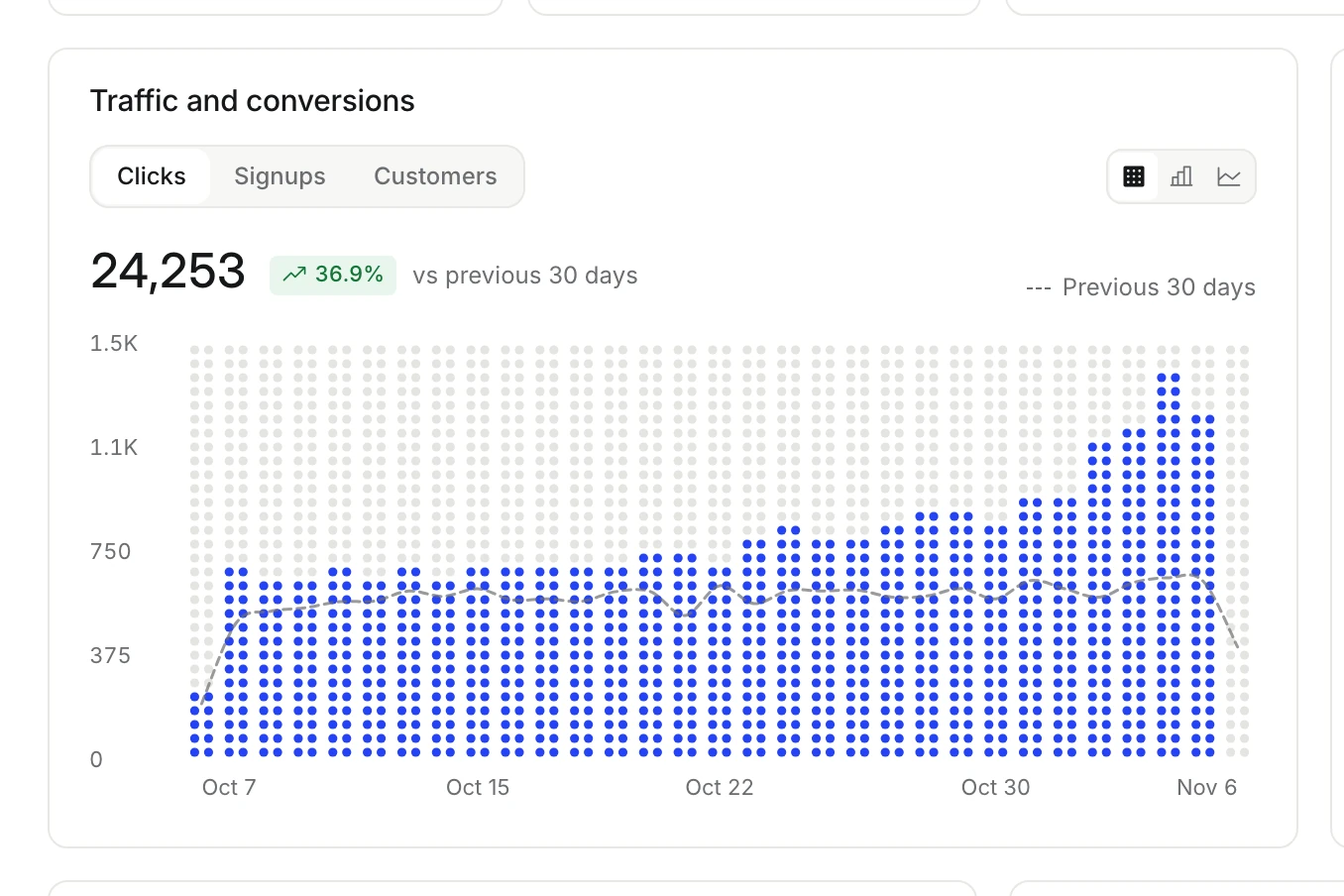
- Active partners: Partners who sent at least one click this month. A quiet partner needs a nudge or a better asset.
- Conversion rate: Paying customers divided by clicks. A sudden jump for one partner can mean self-referral.
- EPC: Earnings per click, or commissions divided by clicks. Partners use it to judge whether your program is worth their traffic.
- Refund rate on referred customers: If it sits far above your normal rate, look at where those customers came from.
Review the program once a month. Message quiet partners and thank the ones who sell. Raise the rate for partners who prove themselves, through tiers or a custom rate.
Mistakes That Sink New Affiliate Programs
New SaaS affiliate programs often break on a few setup choices made in the first month. Each one is cheap to avoid at launch and expensive to fix once partners depend on it. These are the five to check before your first invite goes out:
- No hold period: Paying commissions on day one means paying for customers who refund next week.
- A window shorter than the trial: Partners lose credit for buyers who were still trying the product.
- Tracking from page views: Commissions booked on checkout visits pay for sales that never happened.
- No brand bidding rule: A partner who bids on your name in ads earns on customers who were already searching for you.
- Tax forms at year end: Chasing W-9s in January delays both payouts and 1099 filing.
Fraud is the other quiet cost. Self-referral, leaked coupons and fake signups all leave traces in the data. Our guide to preventing affiliate fraud lists the signals and the rule that stops each one.
Where OpenPromoter Fits
OpenPromoter is an open-source affiliate tool that covers each step in this guide. It proposes commission terms from your Stripe prices and books commissions from billing webhooks. It holds them through your refund window and prepares payouts for a person on your team to approve.
It works with Stripe, Paddle, Lemon Squeezy, Polar and Chargebee. It collects W-9 and W-8 forms in the partner portal and exports 1099-NEC data.
You can self-host it for free under AGPL-3.0, or use Cloud for free up to $1,000 a month in partner revenue. Paid plans cost $29, $79 or $199 a month, and OpenPromoter pricing lists what each includes. It takes 0% of payouts on every plan.
It is a newer project than the older hosted tools. It has fewer published reviews. A team that wants a long track record over source access may prefer an older tool.
Conclusion
Knowing how to start an affiliate program for SaaS is mostly about making the boring decisions before the first partner joins. A commission you can afford and a cookie window longer than your trial come first. A hold period that matches your refund window protects you from paying twice.
Then write short terms with an FTC disclosure rule and test one purchase end to end. Collect tax forms at signup, because the 2026 1099-NEC threshold of $2,000 still needs a W-9 on file.
Start with five to ten customers who already like the product. Their results will tell you whether to raise the rate, add tiers or widen the cookie window.
Frequently asked questions
How long does it take to start an affiliate program for SaaS?
Most founders can set the terms and tracking in about a week. Connecting billing and installing a tracking script usually takes an afternoon. Recruiting the first five to ten partners takes another few days of personal outreach.
Do I need affiliate software or can I track referrals myself?
You can track a handful of partners by hand with coupon codes and a spreadsheet. It breaks once you need recurring commissions, refunds, clawbacks and tax forms. Affiliate software reads your billing webhooks and keeps that ledger for you.
Should SaaS affiliate commissions be recurring or one-time?
Recurring commissions usually fit subscriptions better, because the partner's reward follows the customer's value. A one-time bounty fits one-off purchases or plans that vary a lot in price. A 12 month cap, which is the OpenPromoter default, keeps long-term margin yours.
How long should an affiliate cookie last?
Pick a cookie window longer than your free trial so slow buyers still count. Sixty days covers most SaaS trials, and 90 days suits annual or high-priced plans. Coupon codes and click ids passed to checkout still credit partners after a cookie is gone.
Do I need to send affiliates a 1099?
A US company usually files a Form 1099-NEC for each US partner paid $2,000 or more in 2026. The IRS 1099 instructions set that threshold and the January 31 due date. Check your own case with a tax advisor.
Can affiliates bid on my brand name in Google Ads?
Only if your terms allow it. Write the rule down before launch. Many founders ban it, because those clicks come from people already searching for you. A tool that flags ad click ids such as gclid helps you spot it.
How much does it cost to run an affiliate program?
The main cost is the commission itself, plus payout rail fees from Stripe, PayPal or Wise. Software ranges from free self-hosted tools to monthly plans, and some tools also take a share of each payout. Add the time you spend recruiting and reviewing partners each month.