Affiliate fraud detection with the rules in plain sight
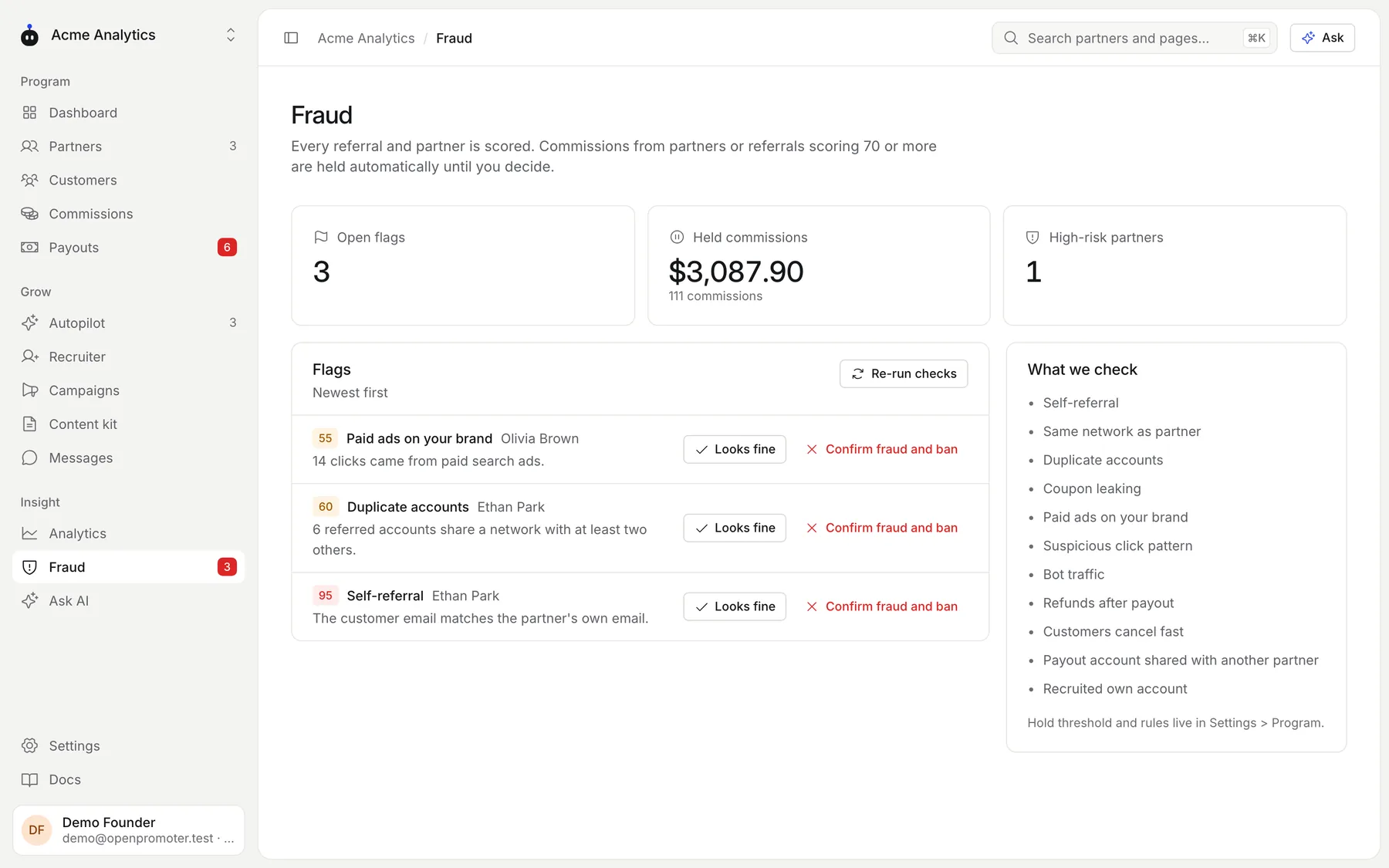
- fraud signals with published rules
- 10
- fraud signals with published rules
- risk score for every referral
- 0–100
- risk score for every referral
- includes every check
- Every plan
- includes every check
The problem
Affiliate fraud shows up after the money is gone
A partner buys through their own link or leaks a code to coupon sites. Another bids on your brand name.
Most programs find out once the commission is paid. Some tools also keep fraud checks for their higher plans.
How OpenPromoter solves it
Every referral is scored before anything is paid
Ten published rules score every partner and every new referral from 0 to 100. Commissions at or above your threshold are held until you review them.
- Self-referral by email and network
- Duplicate accounts
- Payout accounts shared between partners
- Coupon leaking
- Paid ads on your brand
- Bot traffic and click bursts
- Refunds after payout
- Rules that need no AI key
The real screens
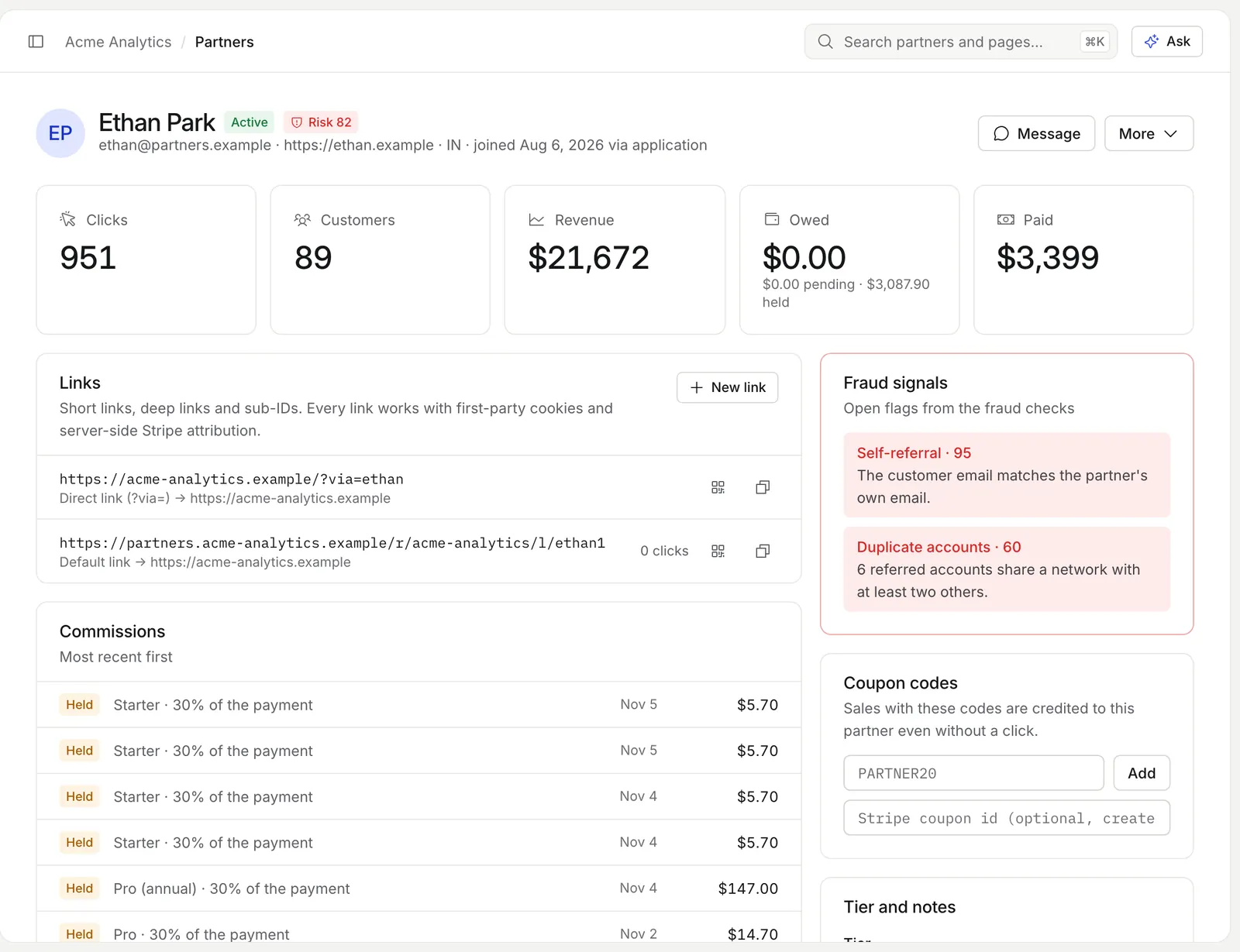
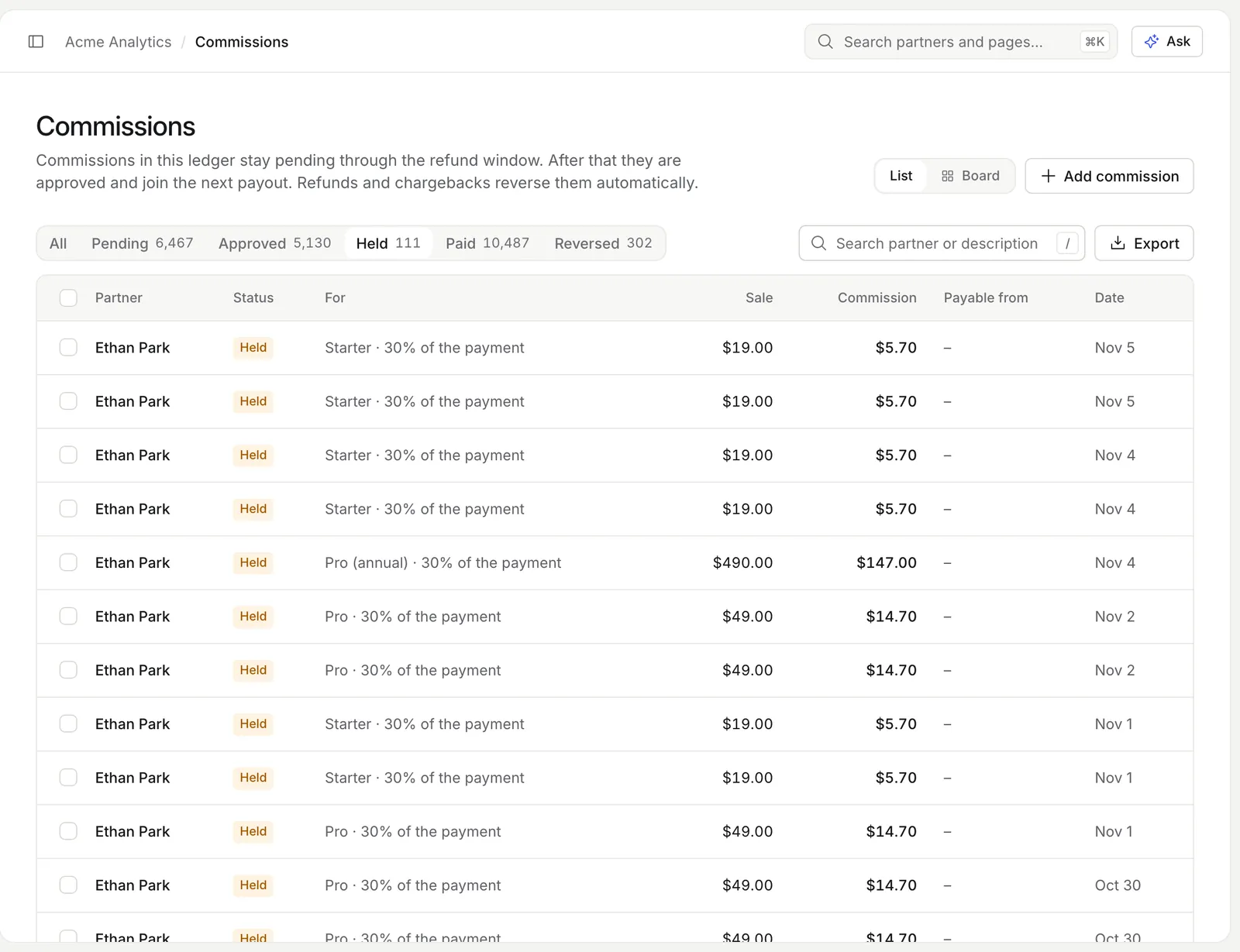
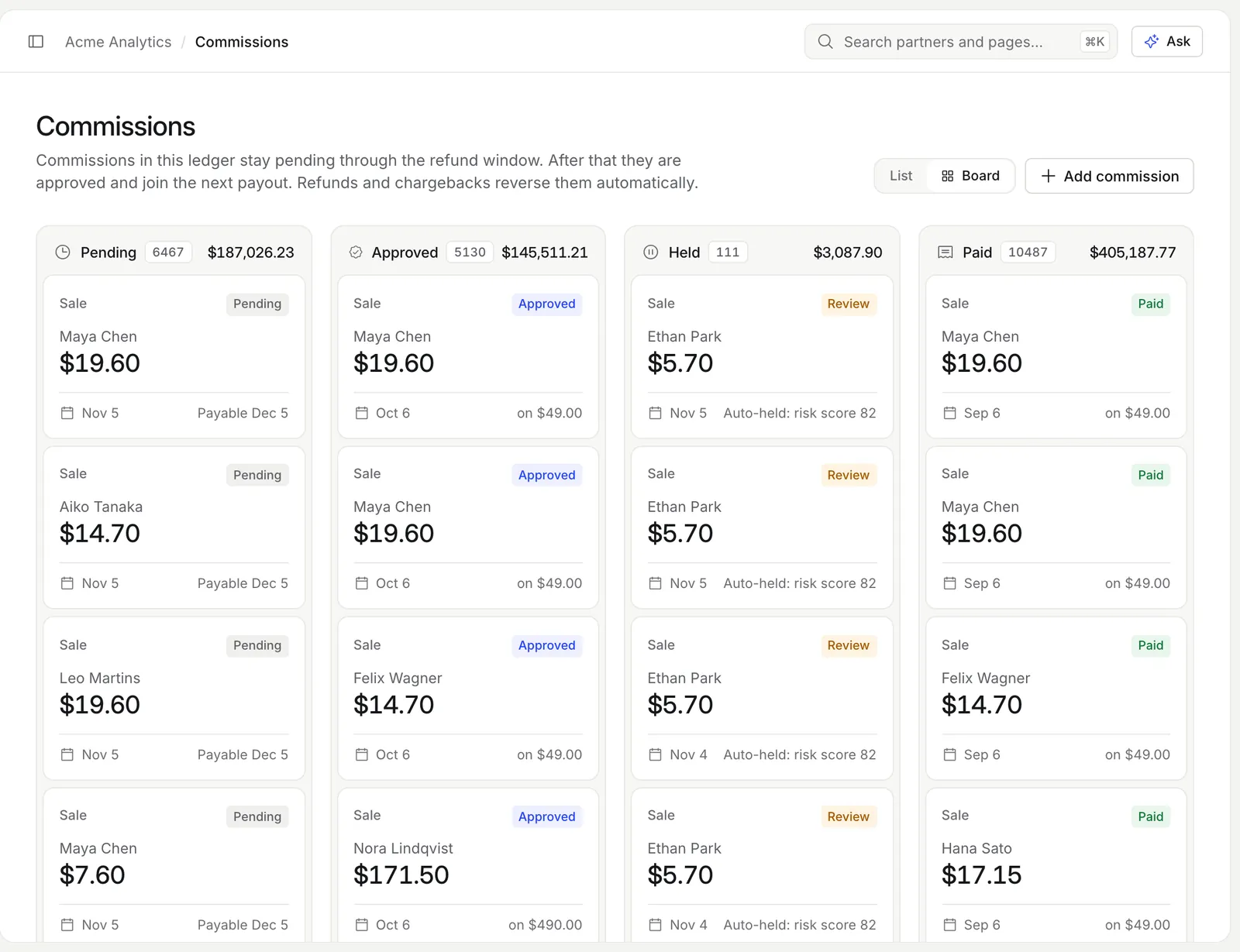
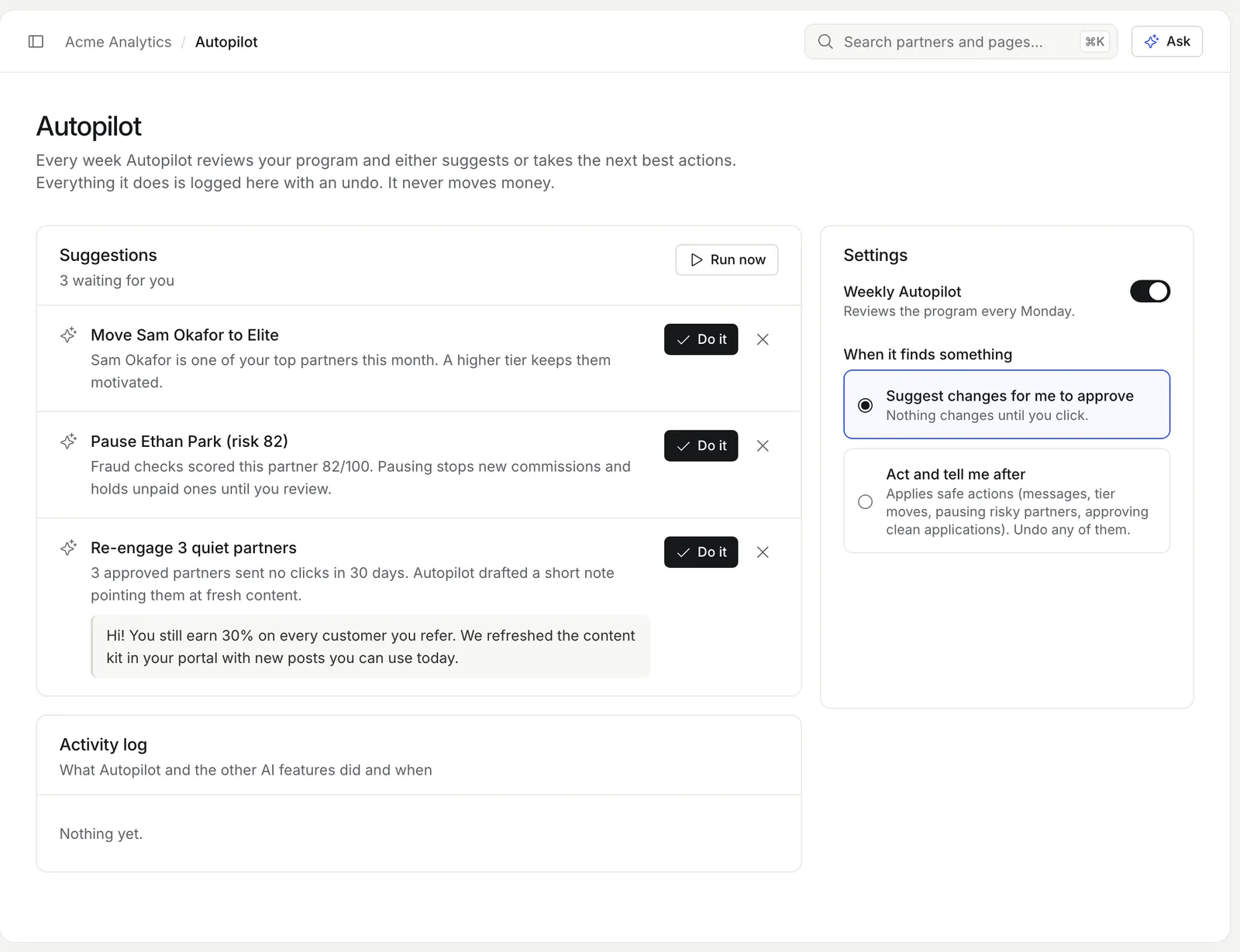
Captured from the demo program in the OpenPromoter app.
How it works
- 01
A referral arrives
Each new referral and each partner is checked against ten signals.
- 02
The signals add up
Every match raises one risk score from 0 to 100.
- 03
Risky commissions are held
At or above your threshold the commission is held. It stays out of every payout while it waits.
- 04
You decide
Choose Looks fine to release it. Confirm fraud to ban the partner and keep the commissions held.
The ten affiliate fraud signals
OpenPromoter checks every partner and every new referral against ten signals. They cover the schemes SaaS programs see most. Each signal is a published rule you can read in the security docs.
Self-referral
The partner and the customer are the same person or share an email alias.
Same network as partner
Clicks or signups from the partner's own IP address.
Duplicate accounts
Several referred accounts that look like one person.
Shared payout account
The same PayPal or Wise account on more than one partner.
Coupon leaking
Coupon sales with no partner click behind them.
Paid ads on your brand
Clicks that carry ad click ids such as gclid or msclkid.
Suspicious click pattern
Bursts of clicks that do not behave like people.
Bot traffic
Crawler, headless and scripted user agents.
Refunds after payout
Customers who refund once the commission has been paid.
Customers cancel fast
Referred customers who churn unusually quickly.
A risk score and a review queue
The signals combine into one risk score from 0 to 100. Commissions on referrals above your threshold are held for review. They wait there instead of being approved.
In the review queue you dismiss a flag with Looks fine. Or you confirm it to ban the partner and keep their commissions held.
Self-referral and coupon leaking
Self-referral is a partner buying through their own link to earn the commission. OpenPromoter matches the partner and the customer by email alias and by network.
Coupon leaking starts when a partner's code lands on a coupon site. Buyers the partner never reached use it at checkout. OpenPromoter flags coupon sales that have no partner click behind them.
Brand bidding detection
Brand bidding is a partner running paid search ads on your brand name. It takes credit for buyers who were already looking for you. OpenPromoter flags clicks that carry ad click ids such as gclid or msclkid.
Ban it in your program terms first. The flag then gives you the evidence to act on it.
Hold periods catch the rest
The hold period stops late refunds from becoming lost money. Commissions stay pending through it for 30 days by default. Set it to at least your refund window.
A refund after payout becomes a clawback on the next payout. A lost chargeback reverses the commission.
Fraud checks on every plan
Every OpenPromoter plan runs the same fraud rules. That covers Free Cloud, paid Cloud and self-hosted programs. Scoring is rule-based and needs no AI key.
Elsewhere fraud tools can sit on higher plans. Tolt's Radar is on its Pro plan at $199 a month. Dub lists risk monitoring on Advanced and above.
Sources: Tolt pricing and Dub pricing (November 2026).
The settings involved
These settings control this feature.
- Auto-hold at risk score
- Settings > Program
- Holds commissions from referrals or partners at or above this score.
- Refund hold
- Settings > Program
- Keeps commissions pending long enough for refunds to arrive.
- Max risk score
- Settings > Applications
- The highest score an applicant can have and still be approved automatically.
- Blocked countries
- Settings > Applications
- Applicants from these countries are left out of auto-approve.
Questions
Something else? The docs cover every setting.
Is the fraud scoring done by AI?
What is coupon leaking?
How does OpenPromoter detect affiliate self-referral?
What happens to a held commission?
How do I stop affiliates bidding on my brand?
Related

[ openpromoter ]
Try it with your own Stripe account
Free on Cloud up to $1k a month in partner revenue or free forever on your own server.